Bring the system. Get a structural resolution in 72hrs.
What follows corresponds to structural function. The sequence is fixed. Nothing has been added for explanation. Nothing required for resolution has been removed. The outcome is determined by structure.
Relationships are determined through:
- constraints
- dependencies
- invariants
- structural interactions
Kieversmith intentionally removes narrative to maximize structural correspondence.
Persistent instability collapses into four structural failure types.
One will match yours.
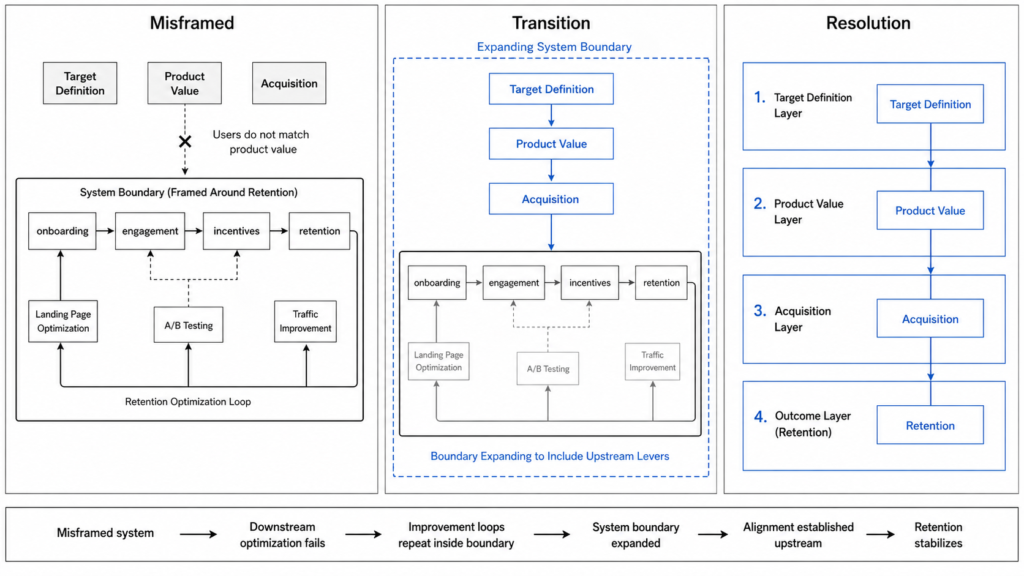
Misframed Problem
Click here to view the structure ↓
System Snapshot
- Traffic is increasing
- Copy is being rewritten
- Landing pages are redesigned
- Performance is tracked closely
Every change is measured against conversion.
Observed Pattern
- Conversion fluctuates without clear cause
- Improvements produce short-term gains, then fade
- Each new version resets performance
- No stable baseline emerges
The system is constantly improved, but the outcome is not controlled.
Structural Diagnosis
- Conversion is treated as the system
- Upstream conditions are excluded
- Optimization occurs within a partial boundary
- The system is defined at the point of measurement
Result:
The system being optimized doesn’t determine the outcome being measured.
Structural Escape Attempts
The system doesn’t lack optimization.
It optimizes continuously within the wrong boundary.
Path A — Improve the landing page
- Rewrite copy
- Adjust layout
- Test offers
Result:
- Some versions outperform others
- Gains are inconsistent
- Performance varies by traffic source
→ The page improves relative to itself
→ The outcome remains dependent on external conditions
Path B — Improve traffic quality
- Refine targeting
- Adjust ad creative
- Increase top-of-funnel intent
Result:
- Higher-intent users arrive
- Conversion improves temporarily
- Performance degrades again over time
→ Input improves relative to previous input
→ The system receiving it remains unchanged
Path C — Optimize through testing
- Run A/B tests continuously
- Iterate on small improvements
- Optimize based on data
Result:
- Local improvements are found
- Each new version resets performance
- No configuration holds
→ Optimization refines the surface
→ The underlying system remains unaddressed
Conclusion:
The system being optimized doesn’t produce the result being measured.
Any improvement within this boundary will remain unstable.
Structural Shift
The system boundary is expanded:
- Pre-click experience is included
- User intent is incorporated
- Offer structure is integrated
- The full journey becomes the system
Resolved Architecture
- Intent formation precedes entry
- Message aligns with user expectations
- Experience maintains continuity
- Conversion emerges from alignment
No single point is responsible for the outcome.
Result
- Conversion stabilizes
- Improvements compound
- Performance becomes predictable
- Optimization produces consistent gains
Structural Proof
Conversion treated as isolated:
→ Page optimized
→ Gains unstable
→ System expanded
→ Alignment restored
→ Conversion stabilizes
State
Structurally stable
Performance governed by correct system boundary
Invisible Constraint
Click here to view the structure ↓
System Snapshot
- Marketing is active
- Sales are working
- Product is evolving
- Operations are executing
All components are engaged.
Effort is continuous across the system.
Observed Pattern
- Output plateaus despite increased effort
- Activity scales, but results don’t
- Improvements fail to increase total performance
- Pressure builds without release
The system is working harder but it isn’t producing more.
Structural Diagnosis
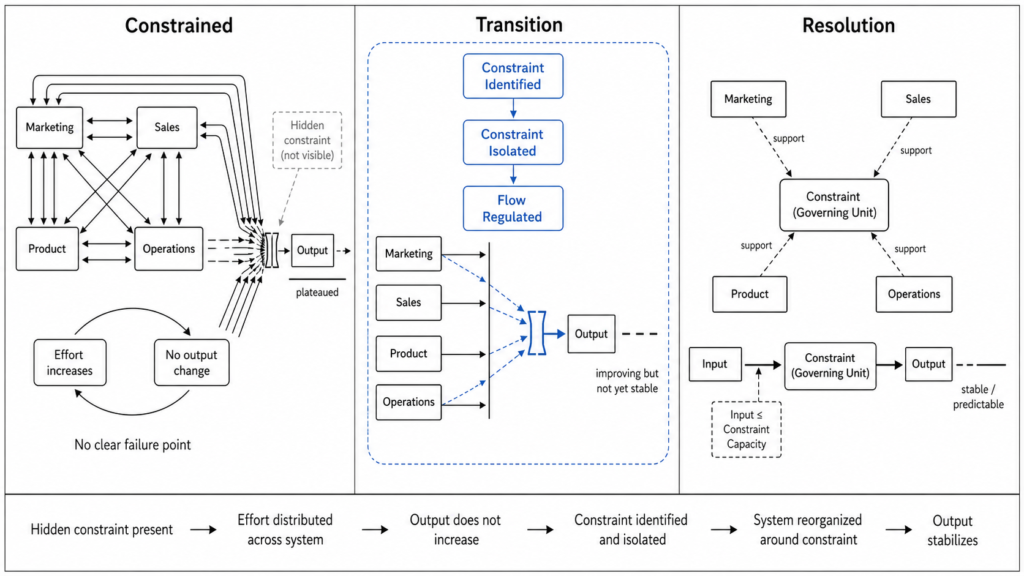
- Output is governed by a single limiting point
- The constraint is not identified or controlled
- Effort is applied outside the limiting point
- System flow exceeds what the constraint can process
Result:
The system is throughput-limited.
Structural Escape Attempts
Effort is applied everywhere except where output is determined.
Path A — Increase Effort Across the System
- Increase marketing spend
- Increase sales activity
- Accelerate product development
Result:
- More input enters the system
- Flow into the constraint increases
- The constraint saturates faster
- Queue buildup expands
→ The system processes more… up to the same limit
→ Everything beyond that accumulates as waste
Path B — Optimize Individual Components
- Improve conversion rates
- Refine product features
- Increase operational efficiency
Result:
- Local efficiency improves
- More units reach the constraint
- The constraint becomes overloaded sooner
→ The system becomes more efficient at delivering work to the bottleneck
→ Total output remains unchanged
Path C — Expand System Capacity Broadly
- Hire more staff
- Add tools and infrastructure
- Increase parallel activity
Result:
- Coordination overhead increases
- More work is generated upstream
- The constraint remains unchanged
→ System complexity increases, but output doesn’t
Conclusion:
Every improvement increases system pressure.
None of them increase system output.
The system is not underperforming.
It is performing exactly at its structural limit.
Structural Shift
The constraint is identified and prioritized:
- The limiting point is isolated
- All flow is aligned to its capacity
- Effort is redirected to increase its throughput
- Upstream input is regulated
Resolved Architecture
- Input is controlled based on constraint capacity
- The constraint governs system flow
- Non-constraint activity is subordinated
- Output reflects the true capacity of the system
Result
- Throughput increases predictably
- Effort produces proportional output
- Queue buildup is eliminated
- System behavior stabilizes
Structural Proof
Hidden constraint:
→ Effort distributed
→ Input increases
→ Constraint saturates
→ Output plateaus
→ Constraint identified
→ Effort concentrated
→ Throughput increases
State
Structurally stable
Output governed by constraint capacity
Contradiction System
Click here to view the structure ↓
System Snapshot
- Features are expanded
- Onboarding is simplified
- Pricing is adjusted
- Retention is optimized
Each area is actively improved.
Each change is correct in isolation.
Observed Pattern
- Improving one area degrades another
- Gains reverse over time
- Trade-offs are unavoidable
- Stability can’t be achieved
No configuration holds.
Structural Diagnosis
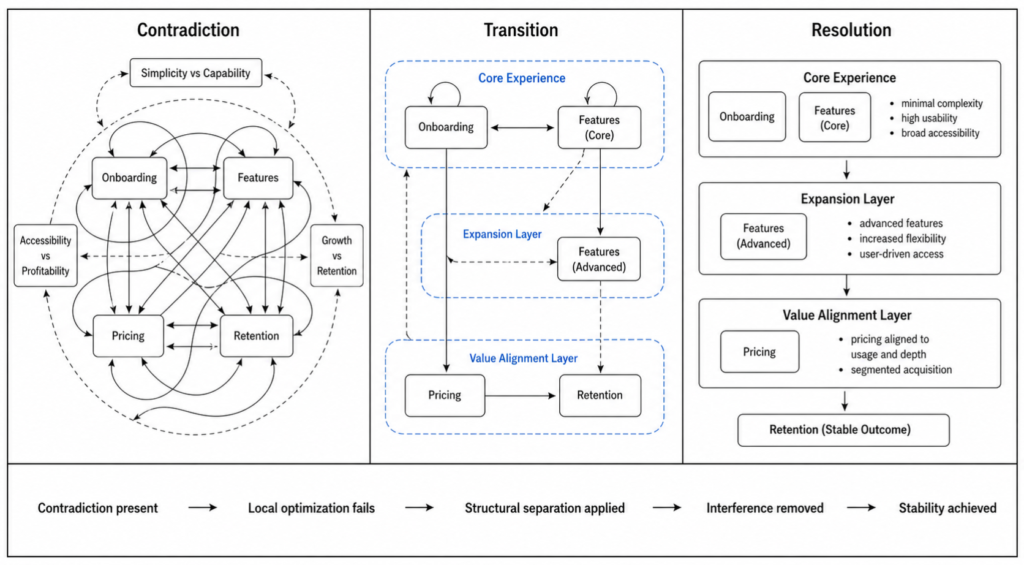
- The system is governed by incompatible requirements
- Core components are interdependent without separation
- Each function operates against the others
Result:
The system can’t stabilize because its conditions cannot be satisfied at the same time.
Structural Escape Attempts
The system doesn’t fail from inaction.
It fails through correct action applied to a conflicting structure.
Path A → Improve onboarding to increase activation
- Reduce friction
- Simplify steps
- Accelerate time-to-value
Result:
- More users enter the system
- Lower commitment at entry
- Engagement quality decreases
- Retention weakens
→ Entry improves by reducing the conditions required to stay
→ The system admits users it cannot retain
Path B → Strengthen retention to improve lifetime value
- Add features
- Increase depth and capability
- Introduce engagement mechanisms
Result:
- Product complexity increases
- Onboarding becomes heavier
- Activation rate declines
→ Retention improves by increasing required engagement
→ The system rejects users it needs to grow
Path C → Adjust pricing to balance growth and revenue
- Test lower pricing to increase conversion
- Introduce higher tiers to capture value
- Repackage offers
Result:
- Lower pricing increases volume but reduces value quality
- Higher pricing improves revenue but reduces entry
- Packaging shifts who enters, not how they behave
→ Monetization redistributes the tension
→ It does not remove it
Conclusion:
Each action improves the system.
Each action produces measurable results.
None of them can succeed together.
This is not a trade-off problem.
This is not an optimization problem.
The system is structured to require conditions that cannot coexist.
→ Any improvement applied within this structure will create failure elsewhere.
Structural Shift
The system is reorganized through separation:
- Conflicting requirements are isolated
- System domains are redefined
- Interference between components is restricted
- Each domain operates under its own conditions
Resolved Architecture
- Onboarding handles entry and activation
- Features handle capability and depth
- Pricing handles value and monetization
- Retention handles engagement and continuity
No domain is required to satisfy another domain’s conditions.
Result
- Trade-offs are removed
- Improvements no longer conflict
- System behavior stabilizes
- Growth and retention no longer oppose each other
Structural Proof
Conflicting requirements forced into one system
→ Local optimization applied
→ One area improves
→ Another degrades
→ Trade-offs persist
→ Requirements separated
→ Interference removed
→ Stability achieved
State
Structurally stable
Contradictions eliminated through separation
System Drift
Click here to view the structure ↓
System Snapshot
The system was previously effective.
- Acquisition was working
- Product delivered value
- Monetization made sense
- Retention was stable
The system operated coherently.
Performance was predictable.
Observed Pattern
- Performance declines gradually
- Changes feel justified and necessary
- Different parts of the system begin moving in different directions
- What used to work no longer produces the same results
Nothing fails all at once.
The system changes… and stops working.
Structural Diagnosis
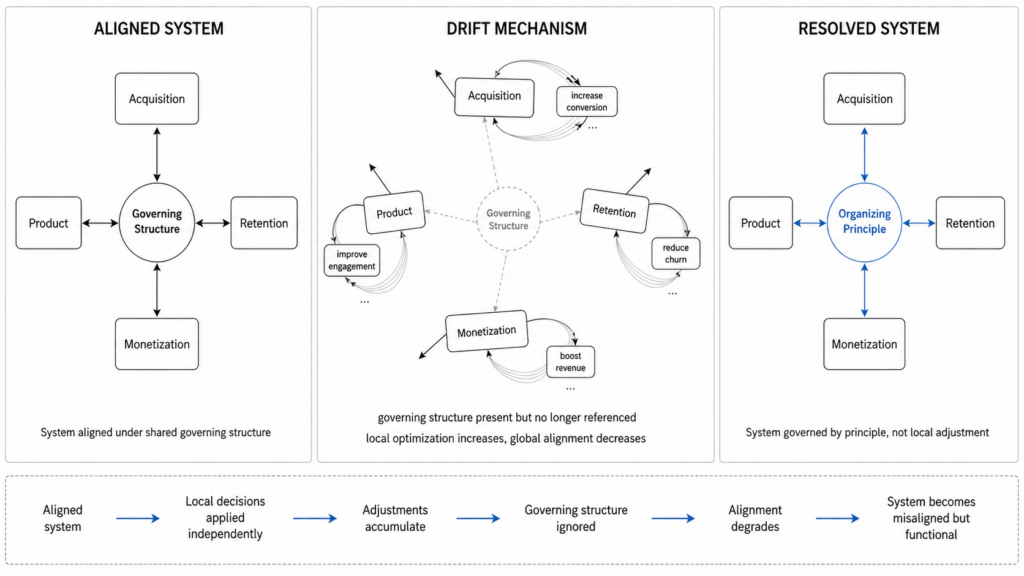
- The system no longer operates under a single governing structure
- Decisions are made locally, not system-wide
- Components evolve independently over time
- No mechanism enforces coherence
Result:
The system is no longer aligned.
It is drifting.
Structural Escape Attempts
The system does not degrade through incorrect decisions.
It degrades through correct decisions made without a unifying structure.
Path A — Improve what’s underperforming
- Adjust acquisition channels
- Tweak product features
- Update pricing or offers
Result:
- Local performance improved
- Other components adjust to compensate
- New misalignments are introduced
→ Each improvement solves a local problem
→ Each improvement weakens system coherence
Path B — Double down on what’s working
Reinforce successful areas.
- Increase spend on high-performing channels
- Expand successful features
- Optimize strong segments
Result:
- Certain components become dominant
- Other components adapt to support them
- System balance shifts
→ The system reorganizes around local success
→ The original structure is replaced without being defined
Path C — Fix issues as they appear
- Address churn when it increases
- Adjust onboarding when conversion drops
- Introduce fixes based on feedback
Result:
- Individual issues are resolved
- Changes accumulate over time
- Direction becomes inconsistent
→ Each fix is correct
→ The system as a whole becomes ungoverned
Conclusion:
Nothing was wrong with the decisions.
Nothing was wrong with the execution.
The system lost the structure that made those decisions work together.
There is no longer anything enforcing coherence.
Without a governing structure, every change—no matter how correct—moves the system further out of alignment.
Structural Shift
A governing structure is introduced:
- A single organizing principle is defined
- All components are mapped to that principle
- Misaligned elements are corrected or removed
- Future changes are constrained by the structure
Resolved Architecture
- Acquisition aligns with system entry conditions
- Product aligns with core value delivery
- Monetization aligns with value exchange
- Retention aligns with continued relevance
All components operate under a shared structure.
Result
- System coherence is restored
- Changes reinforce rather than conflict
- Performance stabilizes and compounds
- Direction becomes consistent
Structural Proof
System aligned:
→ Local improvements applied
→ Components evolve independently
→ Coherence weakens
→ Governing structure dissolves
→ Drift emerges
→ Structure reintroduced
→ Components realigned
→ Coherence restored
State
Structurally stable
System governed by a single organizing structure
Download Full Demo + Questionnaire
No sign up. Immediate download
AI produces variation.
Consultants produce opinions.
Frameworks produce templates.
None of them produce convergence.
Kieversmith does.